
Blueberry Substrate and Root Health Handbook: Success Starts Not with the Soil, but with the Right System
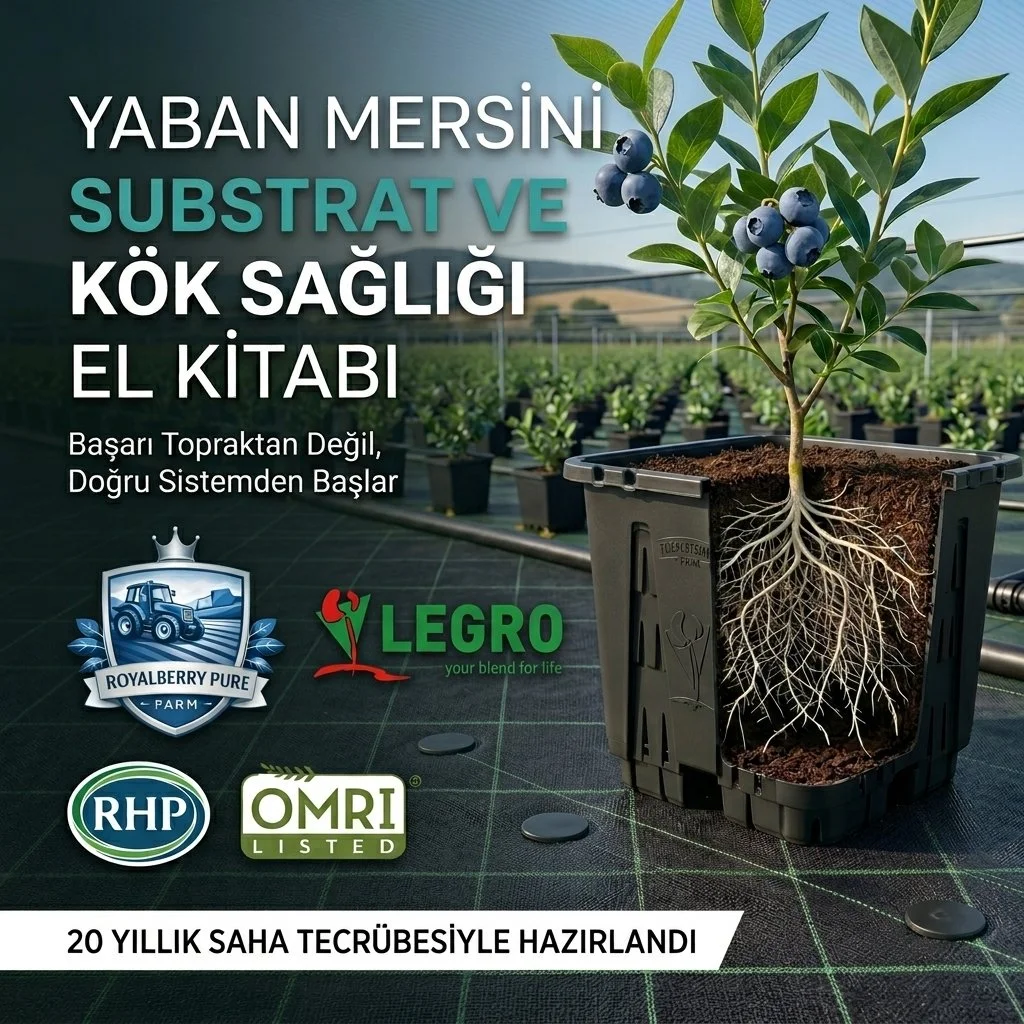
1. Introduction: The "Invisible" Hero of Blueberry Cultivation: The Root Zone (Rhizosphere)
The first image that comes to mind for an entrepreneur planning to invest in blueberries is that of deep blue, misty berries hanging from the branches. However, our 20 years of field experience tells us this: "We are not fruit growers; we are root growers." That magnificent yield above ground is actually the result of a silent, flawlessly functioning machine beneath the soil—the root zone (rhizosphere). RoyalBerryPure —this is why we position ourselves not merely as a supplier, but as the "System Architect" of this delicate ecosystem.
"The blueberry's root system is the plant's brain. If the roots are deprived of oxygen, starve due to 'nutrient lockout' caused by improper pH levels, or strangle themselves by growing in circles inside the pot, the result will be a failure no matter how much fertilizer you apply. Success must be engineered with a disciplined approach that does not leave this micro-ecosystem to chance."
To understand why roots are so selective, we must first look at their "culinary" preferences—that is, their pH levels.
2. Chemical Fundamentals: The Relationship Between the Ideal pH Range and Plant Nutrition
For the blueberry plant, a pH range of 4.2–5.0 is not merely a "preference" but a biological necessity. This narrow range determines the plant’s access to nutrients (particularly micronutrients such as iron—Fe). When the pH rises above 5.5, a chemical barrier forms even if nutrients are present in the environment; we call this "nutrient lockout." Despite the abundance of nutrients available, the plant begins to suffer from "starvation."
Once chemical balance has been established, it is necessary to strengthen the "transport network"—that is, the vascular tissues—that will carry these nutrients.
3. Root Architecture and Air Pruning Technology
The biggest barrier to productivity in traditional pots is "root-bound . When roots hit the pot wall and find no room to grow, they begin to twist in a "spiral" (circular) pattern. This constricts the root and paralyzes the vascular system. RootMax™ pot systems solve this problem Air Pruning technology and strategic Square geometry. The square shape provides maximum ground stability and resistance to tipping in windy areas, unlike round pots.
Root Pruning vs. Air Pruning:
Vascular Activation: Scientific research has demonstrated that the air pruning system activates the transcription factors VcVND6, VcVND7, and particularly VcMYB46, which are associated with xylem differentiation and cellulose synthesis in plants. This activation peaks on days 7, 21, and 42 of the treatment, significantly increasing growth rates.
Fibrous Root Explosion: When the root tip comes into contact with the air in the pot’s drainage hole, it is “naturally pruned.” This sends a signal to the plant to “produce more lateral roots.” The result is a massive mass of fibrous roots with a maximized nutrient-absorption surface area, rather than tangled spiral roots.
Transplant Strength: The branched root structure accelerates the post-transplant adaptation process, thereby shortening the payback period.
Building a strong root system is not enough; protecting that system from the destructive effects of water and disease is also vital.
4. Drainage and Pathogen Management: Controlling Root Rot
Poor drainage is an open invitation to Phytophthora cinnamomi (root rot), the most dangerous enemy of blueberry cultivation. Puddles of water not only suffocate the roots but also act as a highway for the spread of pathogens.
The 3 Key Benefits of Drainage:
Aeration:RootMax™ Thanks to the raised base design of the pots, the root zone is constantly able to breathe.
Rapid Drainage: Multiple drainage channels prevent the substrate from becoming waterlogged and suffocating the roots.
Biological Barrier: The pot’s raised, legged design physically breaks the “pathogen bridge” between the soil and the pot. This is the most natural and effective line of defense against diseases.
Even if the physical and chemical structure is properly established, the sustainability of this quality must be certified in accordance with international standards.
5. Quality Assurance: The Role of RHP and OMRI Certifications
There is no room for surprises in professional investing. In this regard RoyalBerryPure , a Dutch global leader that has been producing raw materials since 1924 and boasts a century of experience Legro, a Dutch global leader that has been producing raw materials since 1924 and boasts a century of expertise. In particular, the Legro CP Optima Export series represents the pinnacle of standardization for blueberries.
RHP CertificationFrom an Investor’s Perspective: It’s a “Zero Surprises” guarantee. You know that every batch will have the same physical structure, the same pH, and the same water-holding capacity. This ensures that a multi-million-dollar investment is based on data, not chance.
OMRI CertificationFrom an Investor’s Perspective: It serves as a passport confirming the product’s compliance with organic farming and export standards. By eliminating the risk of chemical contamination, it enhances competitiveness in the global market.
Once we’ve ensured the quality of the substrate, we move on to the final step that will make the entire system rock-solid in the field.
6. Subgrade and Stability: Jute Geotextile and Stabilization
Ground Cover in a Modern Garden (Jute/Ground Cover) and pot anchoring (PinMax™)form the backbone of the system. If wind, mechanical forces, or water flow displace the pots, drip irrigation lines become damaged and root stress begins.
When all these components come together, blueberry production ceases to be a matter of chance and becomes a measurable engineering achievement.
7. Conclusion: A Summary of the Golden Rules for Beginners
When starting a blueberry farm, use this 5-point professional checklist as a guide:
[ 1 ] pH and Nutrient Management: Verify that the pH is within the 4.2–5.0 range and that there is no risk of "nutrient lockup."
[ 2 ] Certified Substrate: 100-year Legro experience, RHP and OMRI certified CP Optima Export and other reliable products.
[ 3 ] Air Pruning: To prevent spiral root growth RootMax™ .
[ 4 ] Improved Drainage: Make sure the bottom of the pot is raised and does not create a pathogen bridge with the soil.
[ 5 ] Soil Stability: The jute mat and pot system, featuring an inverted claw structure PinMax™ with a reverse-claw design.
RoyalBerryPureWith 20 years of field experience, RoyalBerryPure doesn’t just help you establish your blueberry investment—it designs it with the meticulous care of a “System Architect” to ensure a sustainable and profitable future.
Frequently Asked Questions (FAQ)
-
The ideal pH range for blueberry cultivation is between 4.2 and 5.0. If this range is exceeded, the plant cannot absorb nutrients, resulting in “nutrient lockup.”
-
Nutrient lock-up occurs when a plant is unable to absorb nutrients from the soil due to pH imbalance, even though the nutrients are present. This typically results in yellowing (chlorosis) caused by deficiencies in iron and micronutrients.
-
Blueberry roots are thin, shallow, and highly sensitive to oxygen. Conditions such as improper pH levels, waterlogging, or root entanglement can rapidly impair root function.
-
Root binding occurs when roots grow in a spiral pattern inside the pot and end up choking themselves. This condition severely limits the uptake of nutrients and water and reduces yield.
-
In the air pruning system, root tips are naturally pruned when they come into contact with air. This process encourages the plant to produce more lateral roots, thereby strengthening the fibrous root system.
-
Air pruning allows the roots to spread over a wider area, increasing their nutrient-uptake capacity. As a result, the plant grows faster and the post-transplant adaptation period is shortened.
-
Root rot typically occurs in environments with poor drainage and waterlogging. Excess water deprives the roots of oxygen, creating conditions conducive to the proliferation of pathogens.
-
Good drainage provides oxygen to the root zone and prevents excess water from accumulating. This helps maintain root health and reduces the risk of root rot.
-
The RHP certificate guarantees that the substrate meets the relevant physical and chemical standards. Consistent quality, pH, and water-holding capacity are ensured in every production batch.
-
The OMRI certification demonstrates that a product complies with organic farming standards. This certification is of critical importance, particularly for businesses engaged in export and organic production.
-
PinMax is a locking fastening system designed to secure planters and infrastructure systems to the ground. It is more durable, corrosion-resistant, and long-lasting than standard metal nails.
-
The most critical mistake is improper substrate and pH management. When the root zone is not properly designed, much of the fertilizer and care provided goes to waste.
Scientific Findings on Blueberry Cultivation, Root Health, Air Pruning, and Drainage Technologies
-
Root pruning significantly increases the expression of transcription factors associated with vascular tissue development (VcVND6, VcVND7, VcMYB46, etc.) in the blueberry (Vaccinium corymbosum) plant 7, 21, and 42 days after pruning. This activation accelerates xylem differentiation and the cellulose synthesis pathway; it improves the transport of photosynthetic products to the roots via vascular tissues. In the group subjected to appropriate root pruning, a significant increase in above-ground biomass and leaf biomass was observed compared to the control.
Source: Chu L. et al. Plants 2025, 14(15), 2269. DOI: 10.3390/plants14152269
-
Air root pruning has resulted in superior root architecture in container-grown seedlings compared to bare-root seedlings grown in field conditions. The air root pruning system prevents roots from circling the pot wall (root-bound) and promotes lateral root branching and the formation of fibrous roots. This root structure maximizes the plant’s nutrient-absorption surface area, thereby expanding the canopy and reducing transplant shock.
-
In warm climates, when root zone temperatures in container-grown highbush blueberry (Vaccinium corymbosum) plants exceed critical thresholds, this negatively impacts root vitality and plant yield. Proper substrate management and cultural practices play a decisive role in managing root zone temperature, thereby reducing heat-induced root stress and growth losses.
-
Root rot caused by Phytophthora cinnamomi is one of the most serious diseases in blueberry cultivation and is most severe in poorly drained, wet soils. Research has shown that cultural practices that improve drainage (such as raised beds and subsoil tillage) significantly reduce disease severity. In container design, multiple drainage channels and air pockets prevent water accumulation in the root zone, acting as a biological barrier against this pathogen.


